
Fast Company asked twenty leaders when they recommend executive coaching, and my answer was to the point, cause it’s how I roll.
Honestly? When I don’t know how to help. Getting an outside perspective, along with strategies to navigate the things they are struggling with, is not something you can provide as a manager when you are so close to it. I’ve seen lightbulbs go off, better habits formed, and the mental health of an employee improve because of great coaching.
Most of the other answers in the article framed coaching as acceleration, polish, or scope expansion, with a focus on senior-level employees. I agree with all of it, but my answer was based on the entire reason I created Skills Survival School.
Sometimes you’re too close, you’ve tried everything, and the issue isn’t something you can fix. Admitting you don’t know how to help feels like failure, but I think that’s a leadership win, and considering we have so few of those, just go with it.
WE’RE FORGETTING THOSE AT THE BEGINNING
Executive coaching is great for senior leaders, but what about the early-career employee who can’t navigate conflict, can’t communicate clearly, or can’t problem-solve? Those missing soft skills are costing you tens of thousands of dollars a year and burning out your managers in the process. Seriously, calculate the cost here.
You can’t coach them yourself; you don’t have the time, the bandwidth, or, let’s be honest, the patience. You also don’t have the framework. Most of us learned this stuff by getting embarrassed in middle school cafeterias, not by reading a book, and you can’t reverse-engineer twenty years of cringe into a one-hour training.
WORKPLACE SURVIVAL
8THIRTYFOUR Skills Survival School came out of nineteen years of running a business, the Women’s Entrepreneurial Fellowship, and watching my fellow business owners choosing not to grow because this generation just seems so d*mn hard.
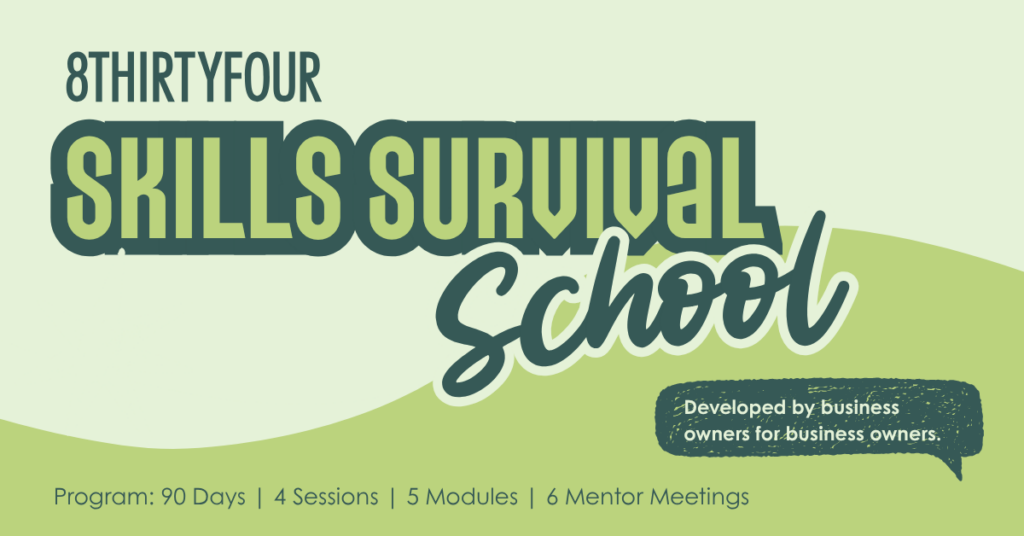
It’s 90 days: 4 sessions, 5 modules, 6 mentor meetings. It includes in-person, eLearning, and self-reflection, with a mentor assigned from your company to serve as their career guide. It’s spread out, to ensure comprehension, but they also have a job to do and can’t be out of the office for days at a time. Trust me, I get it.
It’s not workforce development. We’re not developing a force, we’re developing a person.
THE FIX.
The cost of doing nothing is one we genuinely cannot afford.
If you’ve been wondering whether to keep trying to fix it yourself or whether it’s time to bring in a resource, here’s your sign.
Skills Survival School, the Founding Cohort starts in September. We are keeping it intentionally small, just like I did for the inaugural cohort of the Women’s Entrepreneurial Fellowship. It also means the cost is lower, so get in while you can.